
-
البريد الإلكتروني: info@kovantowaste.com
Industrial Waste Containers: Galvanized Steel Options from 660L to 3200L
Factories, hotels, hospitals and construction sites need large, robust containers. Compare galvanized steel options from 660L to 3200L, plus the lifting systems that empty them.
When waste volumes outgrow wheelie bins, facilities move to large four-wheel containers: 660L and 800L units for mid-size operations, 1100L as the industry workhorse, and 1700L, 2500L or even 3200L for the busiest back-of-house and industrial sites. This guide maps the galvanized steel options and explains the lifting, mobility and corrosion requirements that decide which container fits your operation.
Where Large Containers Are Needed
- Factory floors and warehouses: packaging scrap, offcuts and rejects accumulate daily and must be emptied by truck.
- Hotels and resorts: kitchen, housekeeping and public-area waste, usually several 1100L units per wing.
- Hospitals and care facilities: segregated streams including clinical and secure waste, each needing its own identified container.
- Retail centres, food courts and airports: dense, high-volume streams with tight collection windows.
- Construction sites: demolition and packaging waste that damages lighter containers.
Capacity Options and Typical Applications
| السعة | Typical applications |
|---|---|
| 660 لتر | Small hotels, offices, restaurants with back yards, light industrial lines |
| 800L | Mid-size facilities, estates, markets |
| 1100 لتر | Hotels, hospitals, malls, airports; the standard four-wheel container |
| 1700L | High-volume kitchens, distribution centres, construction collection |
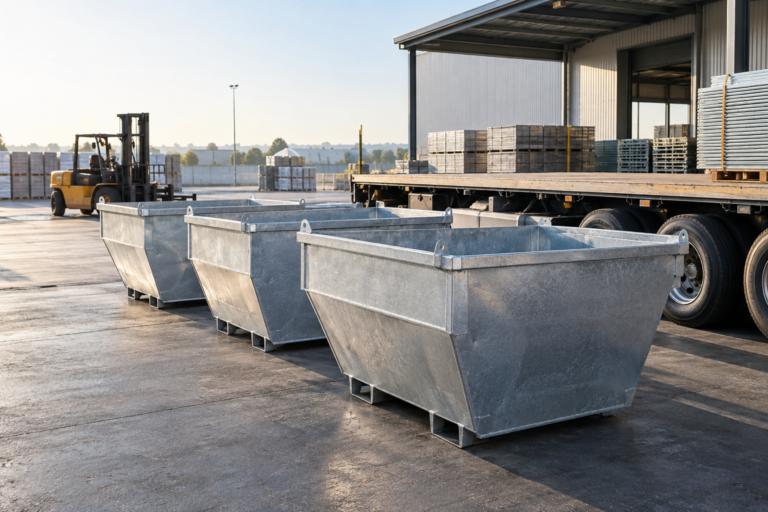
| 2500L – 3200L | Large industrial plants, transfer areas, roll-off style holding |
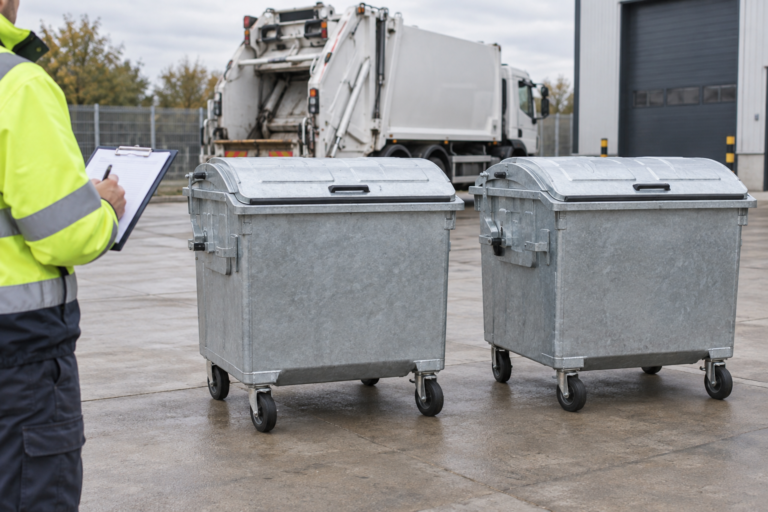
Galvanized steel is the dominant material in this class because of its combination of strength, fire resistance and longevity under industrial abuse. Plastic four-wheel containers exist, but for permanent industrial positions, steel removes the puncture, heat and UV risks.
Mobility: Four-Wheel Design and Brakes
Large containers weigh tens of kilograms even when empty, and much more when full, so mobility is engineered, not incidental:
- Swivel casters with two braked units allow precise positioning and safe parking on slopes and in freight lifts.
- Reinforced mounting plates and channelled bodies distribute load so the container does not twist on rough floors.
- Wheel diameter and tread are matched to the floor type; dense rubber reduces noise in indoor service.
- Handles, push bars and recessed grips let one or two operators control the load without strain.
Lifting and Emptying Systems
The emptying method decides the container specification, so confirm it first:
- Bar lifting: the universal system for rear-loading trucks; rims are reinforced to take repeated lifts.
- Comb lifting: common for plastic bodies, also offered on some steel models for mixed fleets.
- Side lifting systems: offset rollers mounted on the container for dedicated side-loading vehicles, common in Middle East collections.
- Hook and crane systems: for the largest containers emptied into compactors or roll-off bodies.
A container that does not match the truck interface is a fleet failure waiting to happen: book a compatibility check, not just a dimension glance.
Why Galvanized Steel for Industry
- Fire safety: smouldering loads from smoking areas or hot production waste are contained, not fed.
- Chemical and corrosion resistance: the hot-dip zinc layer per ISO 1461 protects against wash-down chemicals and outdoor conditions.
- Impact strength: forklift bumps dent steel; they crack and split plastic bodies.
- Longevity: with basic care, an industrial galvanized container serves a decade or more.
Surface Finish and Colour Options
Galvanized containers can be supplied plain (zinc-grey, maturing to a uniform grey) or with a powder-coated finish in site or corporate colours, useful for stream identification and security team ownership. Specify coating quality carefully: cheap paints fail on zinc; a proper pre-treatment and curing line keeps the colour tight for years.
Special Options for Sensitive Sites
- Double lids and lockable lids for hospitals and secure sites.
- Colour-coded bodies and lids for segregated hospital, kitchen and recycling streams.
- Sign frames and printed panels to prevent cross-contamination of streams.
- Nesting and knock-down variants to reduce shipping volume and storage footprint.
Buying Checklist
- Confirm the truck lifting interface and take the container dimensions to the waste room before ordering.
- Choose capacity with 30% headroom over measured weekly volume.
- Verify caster brakes, swivel behaviour and door clearance.
- Specify galvanizing and optional powder coating rather than raw painted steel.
Conclusion
Large galvanized steel containers from 660L to 3200L are the backbone of industrial and commercial waste handling: robust against abuse and fire, easy to keep hygienic, and engineered for direct mechanical emptying. Specify the lifting interface first, match capacity to real volumes, and the container becomes a long-lived asset rather than a recurring cost.
KOVANTO builds the 660L galvanized container, the 1100L hot-dip galvanized container and 2.5m³ units, with side-lifting and custom options. Contact info@kovantowaste.com to match a container to your fleet.