Follow the production journey of a galvanized steel waste container, from steel coil through forming, robotic welding, hot-dip galvanizing, finishing and assembly, and learn what to audit as a buyer.
Durability is decided in the factory, not at the point of sale. A galvanized steel waste container that survives fifteen years outdoors is the product of controlled steel selection, precise forming, sound welds, a correct galvanizing bath and careful assembly. This guide walks through the full manufacturing process and explains which stages a buyer should audit, in person or through production reports, before paying for a container order.
Production starts with steel coil of defined grade and thickness. Body thickness is matched to capacity and duty: two-wheel bins use lighter sheet, while 1100L industrial containers need heavier plate to withstand forklift bumps and lift loads. The coil is uncoiled, levelled and cut to blank sizes for the body, lid, wheel pockets and fittings.
Audit point: confirm the declared steel grade and thickness against mill certificates, because they are the cheapest corner a supplier can cut.
Blanks are formed on press brakes and roll-form lines: the body panel is bent and flanged, the rim rolled, the lid pressed to its profile, and stiffening channels formed into the side walls. Accurate forming at this stage determines whether the container meets EN 840 dimensions and whether lids seat correctly later.
Robotic MIG welding joins the body seams, mounts wheel brackets and attaches handles or rims. Automation brings repeatability: consistent penetration, even bead profiles and no burn-through. Manual welding still appears on fittings and repairs, where skill variation shows.
Galvanizing only protects a clean surface. The assembled shell is degreased to remove oils, pickled in acid to remove mill scale and rust, then fluxed to prepare the steel for the zinc bath. Skipping or rushing these stages produces patchy coating and early rust, so a trustworthy factory treats this line as sacred.
The prepared shell is immersed in molten zinc (around 450°C) and withdrawn to drain. The result is a metallurgically bonded zinc coating that protects the steel by barrier and by sacrificial action, in line with ISO 1461 thickness requirements that vary with steel section thickness. Coating thickness is measured after cooling with magnetic gauges.
Many buyers order powder-coated finishes over the galvanized layer: the zinc protects the steel, and the powder coat provides colour, aesthetics and extra barrier protection. The coating line must pre-treat the galvanized surface, apply the powder electrostatically and cure it in an oven. Colour is matched to RAL or custom references, and flexibility lets buyers brand entire fleets.
Wheels and axles are fitted with correct torque, casters are mounted with reinforced brackets, and lids, hinges, locks, handles and feet are installed. In the best factories, every container receives a dimensional check against the go/no-go gauge, a wheel and lid function test, and a final visual inspection before labelling.
Export manufacturers then package to survive ocean freight: galvanized shells may be nested or knocked down where the design allows, pallets are strapped and wrapped, and million-unit experience shows in low damage claims. Packaging choice directly affects arrival condition and freight cost, so confirm it in writing.
| Process step | Key quality check |
|---|---|
| Blanking | Steel grade and thickness versus mill certificate |
| Forming | Dimensions versus EN 840 drawing, lid fit |
| اللحام | Seam integrity, weld procedure tests, deburring |
| Pre-treatment | Clean surface before bath, line control |
| Hot-dip galvanizing | Coating thickness per ISO 1461, coverage at corners |
| Finishing | Colour match, curing, adhesion |
| التجميع | Torque, wheel function, locking and lid test |
| Packing | Counts, nesting, strapping, marking |
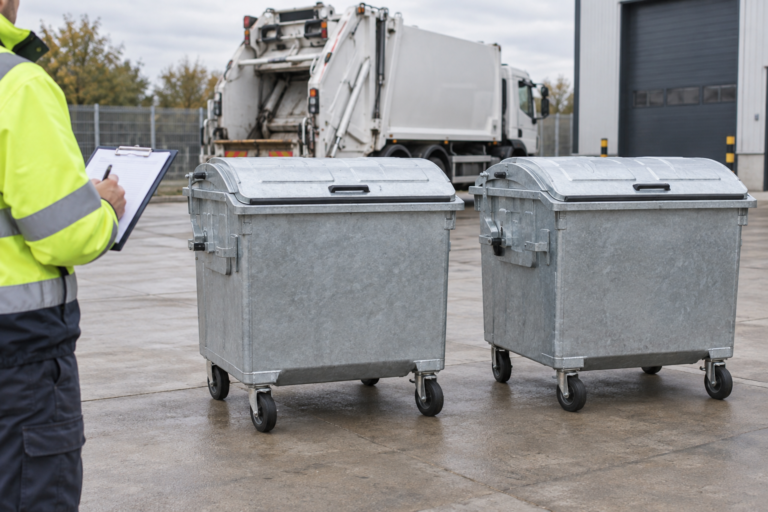
Consistent forming keeps every container compatible with refuse truck lifters. Correct galvanizing makes the difference between a ten-year and a two-year coating. Sound welding prevents bin failure at the worst moment, the collection point. A distributor who audits the process buys reliability, not just price.
From coil to finished container, every stage of production shapes the final product’s lifespan and compatibility. Ask your supplier for mill certificates, coating reports, weld procedure documentation and production milestone photos, and if possible visit or video-audit the galvanizing and welding lines.
KOVANTO operates this full process in-house, including robotic welding and hot-dip galvanizing, and publishes production records for customers. Request a factory tour or QC report at info@kovantowaste.com, and see the results in the metal wheelie bin range or the 1100L galvanized containers.