

Wheelie bin weights and manual handling safety: typical empty and full weights, lifting guidance, and design choices that protect collection staff.
Every day, collection crews and facility staff push, pull and often lift wheelie bins that weigh far more than most people realise. A ‘light’ plastic 120L bin can pass 60 kg when fully loaded with wet waste, and a 1100L container should never be handled by one person at all. Manual handling injuries are the most common workplace injury in waste operations. This guide explains realistic bin weights, the guidance that applies, and the container choices that reduce risk before a single lift happens.
A wheelie bin’s total weight is the empty container plus its contents. Two variables drive it:
The practical result: a full 240L bin of wet household refuse commonly weighs 40–60 kg, and overfilled bins exceed the limits that staff guidance treats as safe for a single person.
Occupational safety guidance and risk assessment frameworks commonly cite a figure of around 25 kg as the upper bound for frequent lifting by a fit adult, with lower limits for repeated lifts, awkward postures and restricted spaces. Limits vary by jurisdiction and by the specific regulation in force, so the legal anchor is your local manual handling legislation and the employer’s duty to avoid hazardous manual handling wherever reasonably practicable. Bin collection is exactly where avoidance is possible: wheels, trolleys, lifting aids and route design remove most of the load.
| Risk | Container solution |
|---|---|
| Overfilled, oversized bins | Right-size the fleet and enforce fill-line limits |
| Failed wheels and stuck casters | Specify sealed bearings, wide wheels, quality casters |
| Shoulder strain during tipping | Use bar-lift trucks, hoists or side-toppling instead of manual tipping |
| Stooping to open lids | Foot-pedal and side-operating lid systems |
| Moving on slopes | Braked casters and handholds on four-wheel units |
The cheapest safety measure is buying the right container: wheels sized for the likely full weight, handles positioned so the bin can be pushed rather than carried, foot-pedal lids that avoid daily stooping, and four-wheel builds with brakes wherever bins stand on slopes. An ergonomic bin range quietly removes thousands of risky movements a year from a site.
Bins are heaviest exactly when staff are rushed, and most injuries trace back to weight, bad routes or failed equipment. Match bin size to realistic loads, enforce fill limits, maintain wheels, use mechanical emptying above the two-wheel range, and design the route for level running. Safety is specified at purchase, not achieved at the collection point.
KOVANTO’s 120L HDPE wheelie bins, metal wheelie bins and 1100L four-wheel containers are specified with quality wheels, handles and braking for safer handling. Ask info@kovantowaste.com about ergonomic options for your fleet.




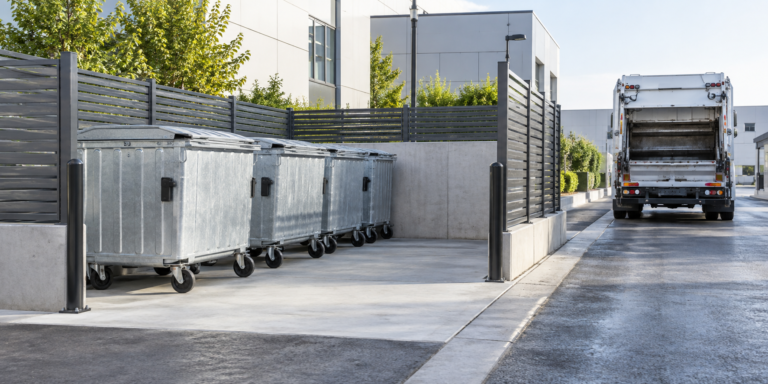
[…] Wheelie Bin Manual Handling Safety […]
[…] Wheelie Bin Manual Handling Safety […]