Colour-coded bins make waste separation intuitive and cut contamination. Learn the common colour schemes, regional differences and the labelling tricks that raise recycling rates.
People recycle when it is easy to understand, and colour coding is the fastest way to make waste separation intuitive. A resident or visitor should not need to read a sign twice: the blue bin is for paper, the yellow one for packaging, the brown one for food waste. This guide explains the conventions used across major markets, the differences that catch buyers out, and how to specify colour-coded bins for your site or municipality.
To harmonise the single market, the European Commission published recommended colours for separate collection. The scheme below is the de-facto reference for many EU projects:
| Colour | Stream | Typical examples |
|---|---|---|
| Blue | Paper and cardboard | Newspapers, office paper, corrugated boxes |
| Yellow | Plastics and metal packaging | Bottles, cans, trays, films (non-biodegradable packaging) |
| Green | Glass | Bottles and jars, separate colours where required |
| Brown | Bio-waste | Food waste, kitchen scraps, garden waste |
| Grey / Black | Residual waste | Remaining non-recyclable household waste |
These are recommendations, not laws: enforcement and the exact shade accepted locally vary, so always confirm the scheme with the receiving facility before ordering a large batch.
For distributors, the lesson is to stock or OEM colour-matched bodies and lids so you can serve several local schemes from one product range. In particular, aim to keep colour consistency: a blue lid on a grey body risks confusing the very people you are trying to guide.
Colour identifies the stream; labelling confirms it and carries the exceptions. The most effective public bins combine both:
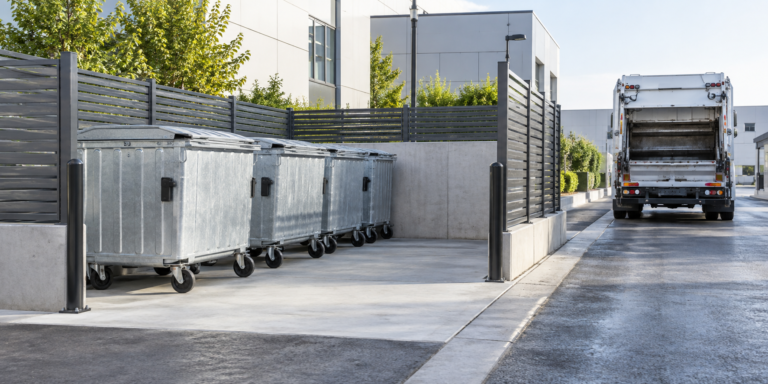
Public banks and office refreshment zones benefit from multi-stream clusters: three to five colour-coded 1100L or 240L bins standing together, with matching lids and pictograms. In estates and camps, keep streams together so separation is a single stop rather than a hunt around the site. For internal waste rooms, tinted lids on standard bodies can save money while preserving the colour signal.
Because schemes differ so widely, container manufacturers offer OEM colour matching: bodies, lids, and full-body colours to a Pantone or RAL reference, plus printed panels if required. KOVANTO’s colour-coded bins are built with this flexibility, and standard lines include the EU palette of blue, yellow, green, brown and grey, in both HDPE plastic and galvanized steel versions.
Colour coding is the cheapest, most effective tool available for raising recycling rates: it removes hesitation, cuts contamination and satisfies compliance requirements. Use the EU palette as your default, verify local rules before large orders, and reinforce colour with pictograms and consistent labelling.
See the KOVANTO 1100L HDPE wheelie bins and 240L HDPE bins, or ask about colour-matched OEM runs at info@kovantowaste.com.