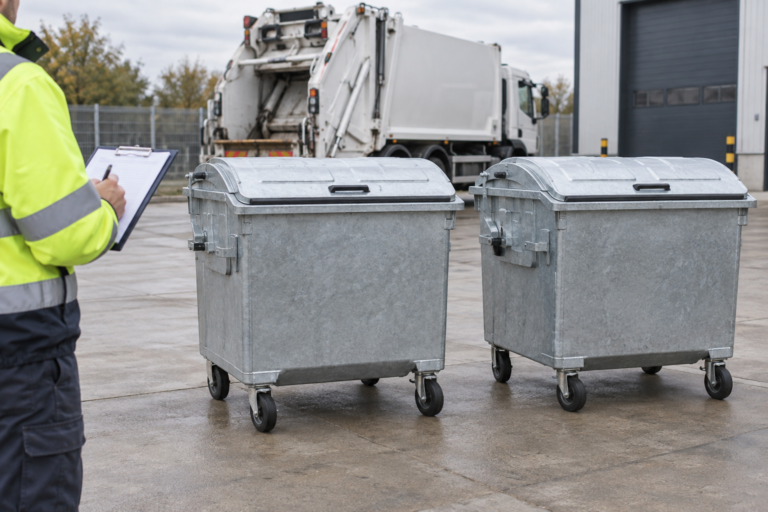

A commercial waste collection point has to work for more than one waste stream, more than one user group and more than one service provider. Offices, retail units, warehouses and shared facilities often need containers for general waste, recyclable materials, packaging or food-related waste within the same footprint. Good design turns that complexity into a safe, simple routine.
The goal is not simply to fit the largest possible containers into an enclosure. It is to create a point where waste can be deposited correctly, containers can be moved and serviced safely, and the site can adapt when volumes change.
Start with the types of waste produced, the points where they arise and the expected pattern over a normal week. A retail backroom may have packaging peaks after deliveries. An office may have steady mixed recycling but lower general waste. A shared commercial site may need separate capacity for several tenants.
Translate that information into practical capacity and access needs. The right container size depends on collection frequency, the available service area and the consequence of an overflow. Avoid selecting a container only because it fits an existing gap; the collection point should support the site’s actual operating pattern.
Separate the route used by pedestrians from the route used to move containers wherever possible. Doors, gates and enclosure walls should allow containers to be positioned and removed without forcing staff to make awkward turns or block a walkway. Check gradients, drainage and surface condition, because castors and handling equipment depend on a stable, clean route.
For sites that use a contractor, walk the route with the service provider before finalising the layout. Their collection vehicle and handling method are part of the design brief.
Container features should solve a defined operational need. Lids can help manage weather exposure and access; locks may be relevant where the waste point is publicly accessible; wheels and brakes influence how units are moved and held in position. Review available waste container options alongside the daily routine, rather than adding features by default.
Where several streams are managed together, use a consistent visual arrangement and clear on-site procedures. Avoid relying on a single sign or one-time staff briefing. New employees, tenants and cleaning teams need an intuitive layout supported by repeatable guidance.
A well-designed collection point still needs ownership. Assign a team or person to check contamination, overfill, damage and access obstructions. Agree how issues are reported and how quickly a full or damaged container is escalated. Keep a basic inspection record for locations with high volumes or multiple users.
That routine also provides useful data. If a container fills earlier than expected, the site can decide whether the cause is collection frequency, a change in waste generation or incorrect segregation. Decisions then become evidence-led rather than reactive.
Commercial occupancy and waste patterns change. Leave enough flexibility for one waste stream to grow, for a temporary container to be introduced or for collection frequency to be adjusted without blocking the route. Modular placement, sensible clearance and a documented layout make these changes easier to manage. Review the collection point whenever a tenant changes, a new service contract begins or a significant waste stream is added. Planning for adaptation does not mean oversizing every element; it means avoiding a layout that only works under one narrow set of conditions.
After several collection cycles, check whether containers, routes and service intervals are still appropriate. Observe peak periods rather than only visiting at a quiet time. Small changes—such as repositioning one container, increasing capacity for a specific stream or improving the approach route—can make a significant difference to staff safety and service reliability.
To review container choices for a commercial site, explore KOVANTO waste containers, see relevant project solutions, or contact KOVANTO for practical guidance.