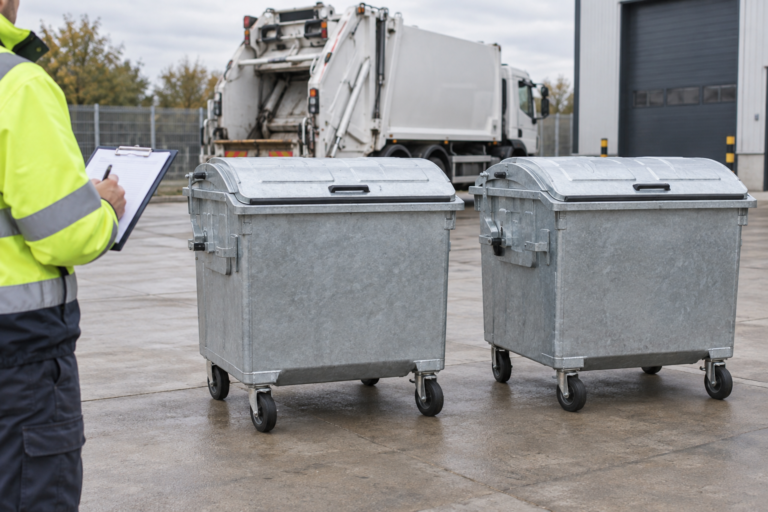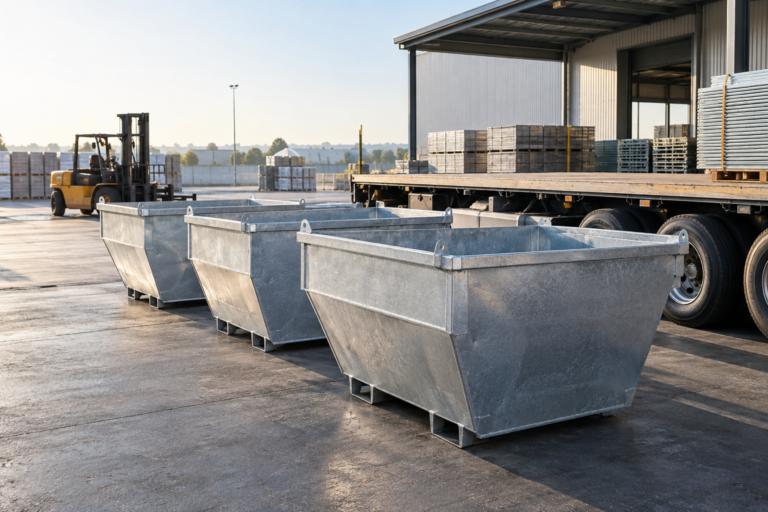

Construction site waste containers: separating demolition, packaging and site canteen waste, choosing 1100L to 2.5m3 galvanized units that survive forklifts.
Construction sites are controlled chaos, and waste is a big part of it: packaging from deliveries, cut-offs, demolition rubble, concrete chippings and the everyday refuse of site canteens and site offices. Containers on a site must survive forklifts, weather, dust and rough ground for the entire project phase. This guide explains how to plan site waste containers that keep the project legal, the site safe and disposal costs predictable.
The most common planning error is mixing construction waste with ordinary site refuse. They are collected, priced and disposed of differently:
Construction volumes run far beyond household-scale bins. Typical choices:
| Container | Typical use on site |
|---|---|
| 1100L four-wheel | General site waste, canteen and office refuse, small packaging runs |
| 1700L – 2500L | Active packaging and cut-off collection on medium projects |
| 2.5m³ and above | Bulk rubble, demolition pulls and compactor feeding |
Match container volume to the site’s waste-generating rate: a medium residential build with one skip delivery a week may need only 1100L wheels for general refuse; a large commercial fit-out with daily deliveries will generate cardboard by the pallet-load.
An open container is a litter and mud hazard. Keep covers or lids on whenever the container is not being loaded, and position bulk containers on firm ground or hardstanding so casters do not sink. Empty and rotate containers before they become dumpsites; a container dragged to the back of the plot is an invitation.
Separated waste is worth money: metal scrap, cardboard and wood have resale or lower-rate disposal values. On larger sites, provide labelled 1100L containers for each stream and post the site waste management plan at the delivery gate. Sites that segregate from day one routinely cut disposal spend versus dumping everything in one container, because mixed loads are charged at the highest rate.
Peak waste arrives at the end: fit-out packaging, offcuts and demolished fixtures. Pre-book larger containers or temporary compactor skips for the final two weeks, arrange same-day removal for flammable packaging, and complete a final waste transfer record so the environmental close-out file is audit-ready.
Construction waste containers need steel durability, big capacities and disciplined segregation. Separate construction from general site waste, choose galvanized four-wheel units of 1100L and up, lock covers against litter and strangers, and segregate recyclables to turn a cost centre into a recovery stream.
Browse KOVANTO’s 1100L galvanized containers, 2.5m³ units and 660L galvanized containers, or ask info@kovantowaste.com for a site-quantity plan.