
Smart waste bin trends: fill-level sensors, solar compactors, app-based access and underground systems - and why robust conventional containers still anchor every city.
Cities are wiring their infrastructure, and waste is no exception. Smart bins promise fewer overflowing containers, cheaper collection routes and cleaner public space, and the technology is already mature enough for procurement. Yet every smart system still stands on a physical container that must be strong, safe and simple to service. This guide separates the real trends from the marketing, and explains how to combine sensors and software with containers built to last.
| Solicitud | Main benefit | Key prerequisite |
|---|---|---|
| High-footfall public bins | Stops overflow between rounds | Reliable network coverage |
| Recycling banks | Data on composition and fill | Access control and power supply |
| Estates and campuses | Reduced patrol trips | Software integration with existing fleet |
| Historic centres | Discreet, high-capacity storage | Civil works and lifting vehicles |
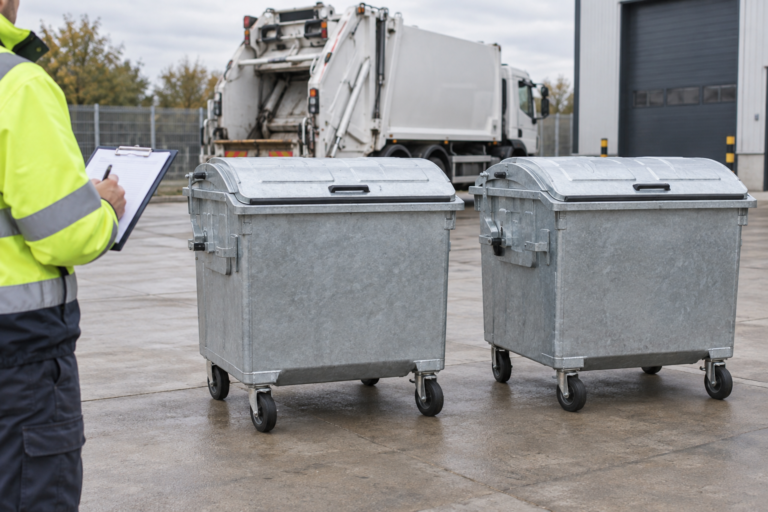
Sensors do not make a weak bin smarter. The physical container still must handle weather, vandalism, fires and daily handling, so the base specification mirrors any public container: galvanized or stainless bodies in exposed areas, sealed lids for wet and odorous streams, locked covers where unauthorized dumping is a risk, and EN 840-compatible interfaces so trucks actually lift the smart bin.
Solar-powered compactors bring the most dramatic public-space gains: one unit can hold the equivalent of five to eight standard bins, which means fewer empty trips and less exposure of waste on the street. They are best in stable, sunny areas with a servicing crew that understands mechanical maintenance; in shaded or extreme-climate sites, the payback stretches and a well-scheduled conventional container may serve better.
Even the most wired city runs the majority of its household and commercial collection with ordinary wheelie bins and four-wheel containers, because they are cheap, robust and universally compatible. Smart systems optimize the collection of these containers; they do not replace them. Most municipal fleets buy smart pilots while renewing the conventional fleet, and the smart wins are shared with the same trucks and depots.
When procuring, prefer manufacturers who can supply the conventional container at EN 840 quality and also mount sensor brackets, access-control lids and compaction hardware without breaking the container spec. A bin engineered for both worlds is a safer bet than bolting electronics onto a household product.
Smart waste management is real and growing: fill sensors, solar compactors and data-driven routes cut costs and keep streets clean. Buy them against measured pilot results, integrate with your existing software, and keep the physical container specification high, because every smart feature still lives inside a container that must last a decade.
KOVANTO supports smart-city projects with 1100L galvanized containers, HDPE wheelie bins and sensor-ready options. Discuss your pilot with info@kovantowaste.com.