

When a municipality, contractor or distributor prepares a waste-container tender, the most expensive mistakes usually happen before suppliers are invited to quote. A short specification can produce offers that look similar on price but differ greatly in service life, collection compatibility, safety and delivery readiness.
This checklist helps buyers define a practical waste container specification before requesting quotations. It is suitable for municipal, commercial and industrial collection projects and can be adapted for galvanized steel containers, outdoor metal bins and wheelie bins.
Describe how and where the containers will be used before choosing a size or material. The collection scenario affects almost every technical decision.
For large projects, it is useful to group locations by use case instead of applying one container type everywhere. A container that works well at a loading bay may not be suitable for a pedestrian public space.
Specify the required nominal volume in litres or cubic metres, then add the maximum footprint and height available at the installation site. Capacity alone does not tell suppliers whether a container will fit under a shelter, through a gate or beside a collection vehicle.
Ask suppliers to provide a dimensional drawing that includes overall width, depth, height, wheelbase and lid clearance. If several capacities are acceptable, state the operating range and let suppliers explain the trade-off between capacity, handling and collection efficiency.
For a general comparison of capacities, see our waste container capacity guide.
Material choice should be based on the environment, waste type and expected service life. For example, projects exposed to salt air, industrial contamination or frequent washing may need a different protection strategy from sheltered commercial sites.
Where hot-dip galvanizing is part of the brief, include the relevant project standard or inspection requirement. Our ISO 1461 galvanizing guide can help procurement teams frame the right questions.
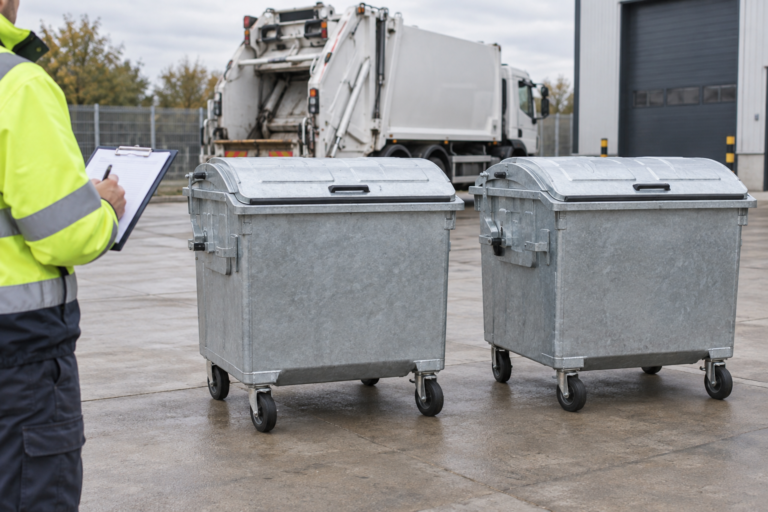
A container is only useful if it works safely with the collection equipment already in service. Put the lifting interface in writing instead of relying on product photos or general descriptions.
Read more about refuse truck compatibility before finalising this section.
Small components strongly affect daily use. Include the details that matter to operators and end users: lid material and opening method, wheel diameter, wheel load rating, brake type, handles, drainage and pinch-point protection.
For public-facing locations, consider noise, weather resistance, fire risk, user access and the likelihood of misuse. For commercial sites, include practical service needs such as replacement wheels, lids and locking options.
State how containers should be identified at delivery. Requirements may include colour, logo, serial number, asset label, recycling stream label, QR code or customer-specific marking. Where colour is important for waste separation, provide the required reference or approval sample rather than using a broad colour name.
KOVANTO can adapt capacity, dimensions, materials, lids, wheels, finishes, branding and export packaging. Review the available customization options before requesting a project quotation.
A good tender tells suppliers what documentation is needed and when it must be provided. This makes quotations easier to compare and reduces disputes before shipment.
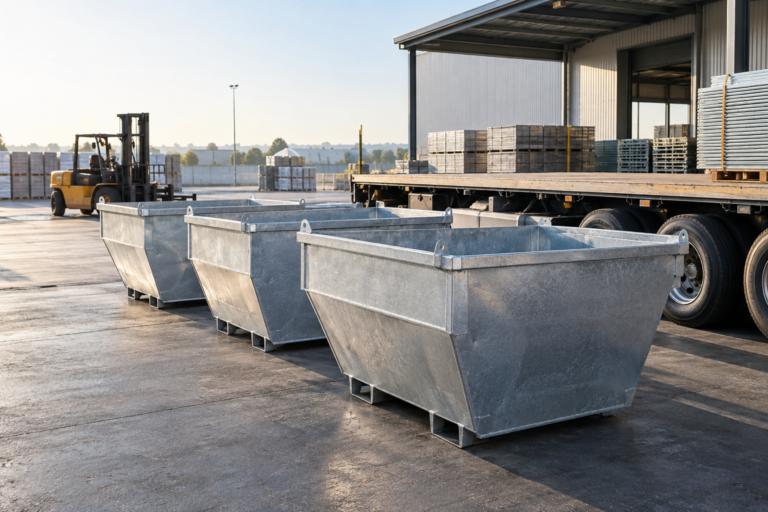
For international projects, packing and container loading should be specified as early as the product. Tell suppliers the destination, preferred Incoterm, any container-loading limits and whether goods must be nested, palletised or protected individually.
Our packaging and shipping overview and freight terms guide explain the information that helps suppliers quote accurately.
Before sending your request for quotation, confirm that the specification answers these questions:
A clear specification gives suppliers enough information to propose the right waste-container solution, while still allowing practical alternatives where appropriate. For help matching container capacity, materials and collection compatibility to your project, contact KOVANTO or review our waste container range.




[…] a structured tender brief, see our waste container tender specification checklist. Product options can be reviewed on the KOVANTO product […]
[…] a structured tender brief, see our waste container tender specification checklist. Product options can be reviewed on the KOVANTO product […]