
Hospital waste bins guide: segregation, foot-pedal and lockable containers, capacity planning and hygiene requirements for healthcare facilities.
Hospitals generate more streams of waste than almost any other building: general refuse, recyclables, clinical waste, pharmaceutical waste, sharps and food waste from kitchens and wards. Each stream has its own container, its own collection route and its own set of hygiene rules. This guide sets out how healthcare facilities select waste containers that meet infection-control needs, staff safety requirements and the space constraints of a busy hospital.
Note that clinical and pharmaceutical waste is governed by national healthcare regulations and is usually collected under a dedicated clinical waste contract. The containers below focus on the general, recyclable and food waste streams that hospitals manage in-house.
| Zone | Container type | Key requirement |
|---|---|---|
| Wards and treatment rooms | 40–120L pedal or swing bins | Hands-free opening, washable surfaces |
| Corridors and waiting areas | Recycling clusters, 60–100L metal tins | Colour coding, fire-safe material, anchoring |
| Kitchens and canteens | 120–360L wheelie bins | Sealed lids, reinforced wheels for wet weight |
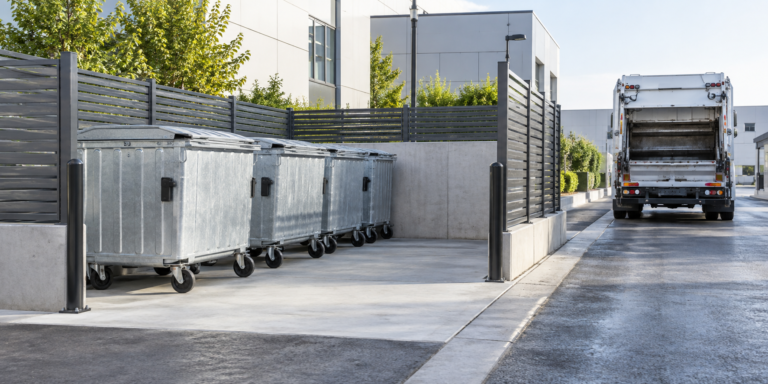
| Back-of-house holding | 660–1100L four-wheel containers | Lockable covers, truck-compatible lifting |
| Waste room | 1100L containers on a schedule | Colour coding, drainable floor, no cross-stream storage |
Infection control favours hands-free operation: foot pedals open lids without touching the bin, swing lids let staff drop waste with a flick of the wrist, and self-closing lids limit airborne particles. In wards, position landfill and recyclable bins side by side so segregation is a one-step habit. KOVANTO offers foot-operated lid systems on both two-wheel and 1100L four-wheel containers, keeping handle-free opening possible even at back-of-house scale.
Always verify that any container planned for clinical-adjacent areas is compatible with the facility’s disinfection regime before purchase.
Ward waste accumulates faster than most planners expect. A useful starting point: size each stream for one full collection interval plus 30% headroom, and never let food or clinical-adjacent waste sit past the declared interval. Bed counts, outpatient footfall and kitchen output all drive volume; record actual bag counts for two weeks before finalising container sizes.
Colour coding and clear labels prevent the cross-stream contamination that triggers compliance failures. Use a site-wide colour scheme, add pictograms listing what belongs and what does not, and mark collection days on containers so staff and contractors share one schedule. Keep a hygiene log: containers are part of the audit trail.
Hospital waste containers must balance infection control, segregation discipline, weight handling and cleaning regimes. Choose hands-free designs for wards, sealed and reinforced bins for kitchens, and large lockable containers for back-of-house holding, then run the whole set under one colour-coded, auditable system.
Explore the 1100L galvanized containers, metal wheelie bins and HDPE wheelie bins from KOVANTO, and ask info@kovantowaste.com about lockable and foot-pedal options for healthcare projects.