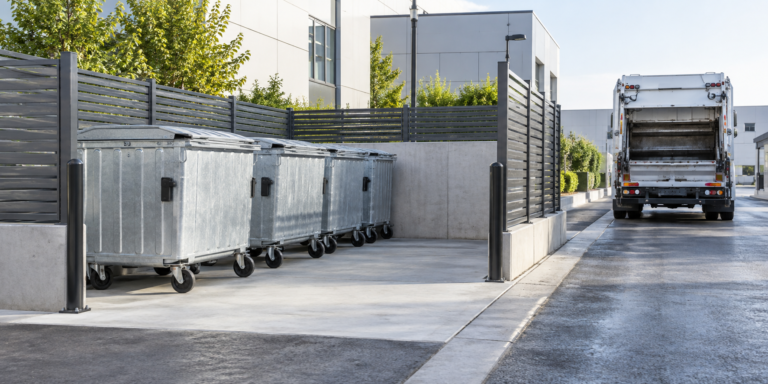

The 660L and 1100L are the two standard four-wheel containers of European waste logistics, and they share the same footprint philosophy: one person connects them to.
The 660L and 1100L are the two standard four-wheel containers of European waste logistics, and they share the same footprint philosophy: one person connects them to a truck, and two wheels handle the weight. The 660L is the nimble middle size; the 1100L is the industry-standard unit that most bin stores and vehicles are designed around.
The table below compares the practical differences that affect daily operation, not just the specification sheet.
| Criterion | 660L container | 1100L container |
|---|---|---|
| Nominal capacity | 660 litres | 1100 litres |
| Typical height | 1180-1250 mm | 1370-1400 mm |
| Plan footprint | about 1265 x 965 mm | about 1265 x 965 mm |
| Weight when full | roughly 150-200 kg | roughly 250-350 kg |
| Handling | still a two-person or mechanical job | always two-person or mechanical |
| Typical users | small hotels, shops, sites with limited yard | municipal, catering, estates, most contracts |
Choose 660L where the bin store is short, the pickup body opens low, or streams are small but need a container rather than a wheel. It also suits sites where the collection vehicle crew regularly positions the container by hand.
Choose 1100L wherever contract frequency is priced per stop: doubling capacity at the same footprint, same lift and roughly the same price point usually halves lift costs. EN 840-compatible 1100L units are also the default that bar-lift and comb-lift trucks are specified against.
If your site can physically handle the 1100L height (1370-1400 mm) and the collection vehicle accepts it, choose the 1100L: same footprint, more capacity and fewer lifts. Pick 660L only where height, door or vehicle constraints force it.
Sitting beside a specification table, the real difference between 660L container and 1100L container only shows up after months of daily use. On Nominal capacity, 660L container is at its 660 litres while 1100L container shows 1100 litres. On Typical height, 660L container is at its 1180-1250 mm while 1100L container shows 1370-1400 mm. On Plan footprint, 660L container is at its about 1265 x 965 mm while 1100L container shows about 1265 x 965 mm.
Any facility manager can list a fleet that looked fine on paper and failed in service. The deciding factors are normally blast rate, lid abuse and whether the cleaner or the collection crew can keep it in one piece for more than three years.
If your site can physically handle the 1100L height (1370-1400 mm) and the collection vehicle accepts it, choose the 1100L: same footprint, more capacity and fewer lifts. Pick 660L only where height, door or vehicle constraints force it.
Beyond the purchase price, compare three numbers before ordering: the expected service life, the cost of replacement lids and wheels, and the painting or galvanizing warranty. A cheaper 660L container unit that needs new caster sets every eighteen months rarely beats a well-made 1100L container body over a five-year horizon.
Once the choice between 660L container and 1100L container is settled, lock down the details that change daily use: lid type and lock, caster size and brake position, drainage holes, and the exact body dimensions for the waste yard. Ask the supplier to confirm each one in writing, then measure one sample unit against the loading bay before committing to a full batch.
Yes; both use the standard four-wheel bar or comb interface, though the lift vehicle must be rated for the heavier full weight of the 1100L.
On flat ground and with quality casters, positioning is manageable, but lifting or emptying is a mechanical job; use trolleys or two-person rules.
Its capacity matches a full rear-loader pass and its footprint fits standard yard and bin-store planning, so contracts and vehicles are written around it.
KOVANTO manufactures 660l Galvanized Steel Waste Container, 1100l Galvanized Waste Container 4, 1100l Plastic Wheelie Bin, with OEM/ODM options in capacities from 50L walk-in bins to 2.5m³ containers. Send your site plan and collection contract to info@kovantowaste.com for a container layout proposal sized to your streams.